Writing
Why AI infrastructure forecasts still won't agree
published: 2026-10-25 · status: canonical · expanded from the original post
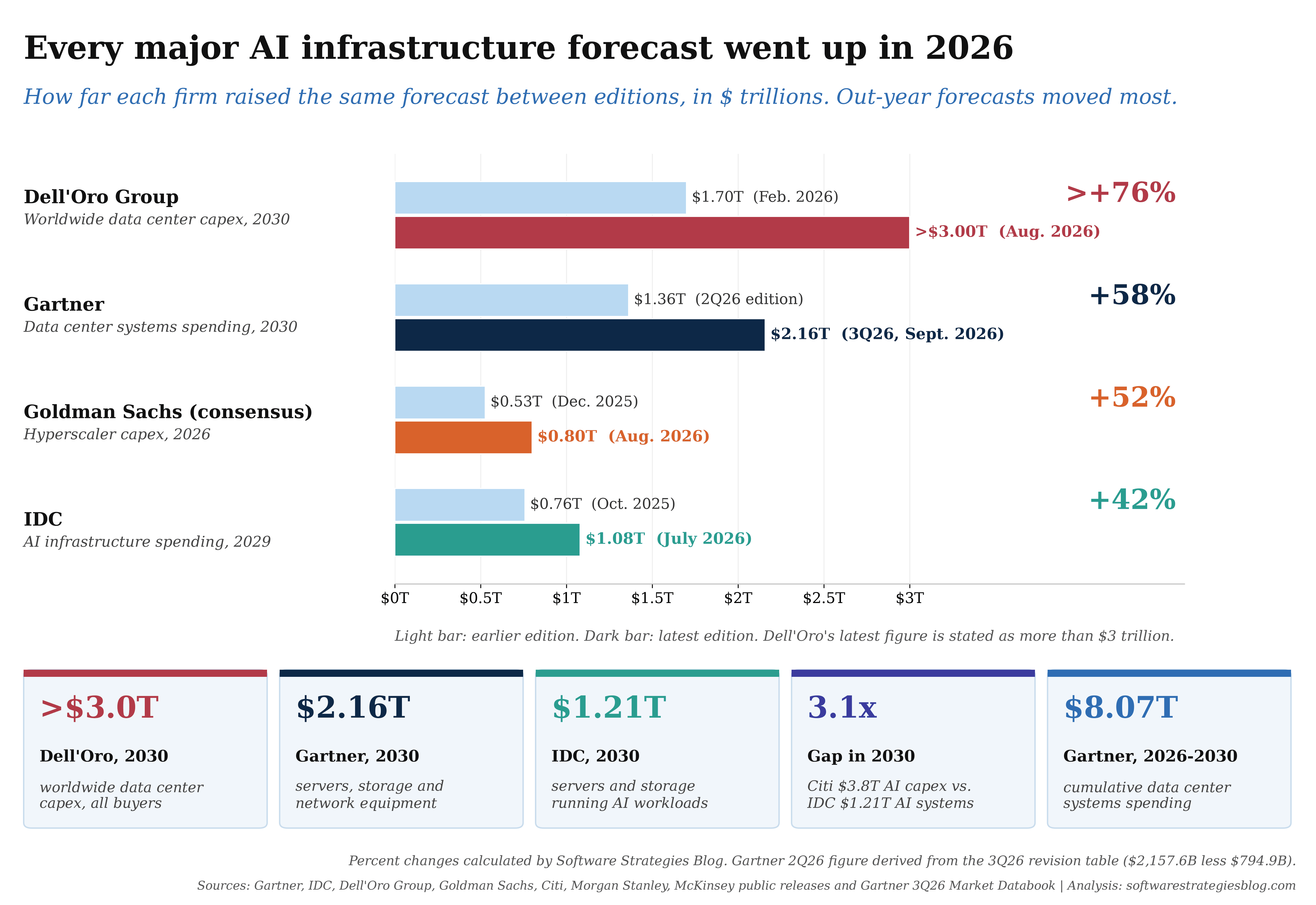
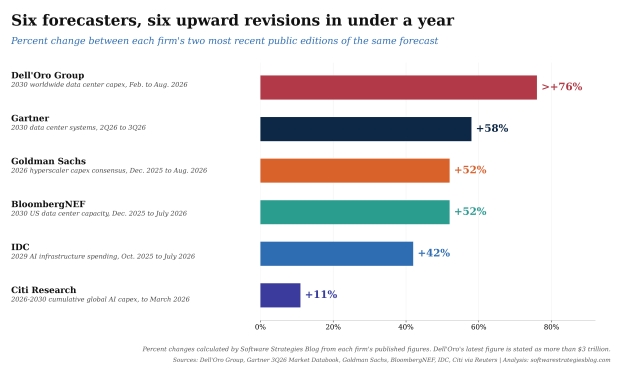
You would assume that by now, forecasts for AI infrastructure spending would converge. Same market, same hyperscalers, same quarterly capex headlines. But line up a dozen research and financial models side by side and the spread is wide enough to make any boardroom pause. That spread is not a rounding error. It is the difference between planning for one level of buildout and planning for something materially larger or smaller.
A recent comparison at Software Strategies Blog, "Why AI infrastructure spending forecasts disagree so dramatically", does not try to resolve the disagreement. That is what makes it useful. It walks through the models from firms like Gartner, IDC, Dell'Oro, and Goldman Sachs and shows that the numbers are not measuring the same thing. Two reasons stand out.
First, definitions differ. Some models count silicon, others count data centers, power, cooling, or services. A forecast that counts only accelerators is answering a different question than a forecast that includes full data center construction, power infrastructure, and managed services. One model can include construction and power while another includes only chips and servers; both can be internally consistent and still look wildly contradictory. The scope mismatch alone can swamp genuine differences in market outlook. You cannot reconcile what you have not scoped identically.
Second, the 2030 numbers bake in assumptions about power availability and the revenue required to justify the buildout, not just demand signals. Demand for AI capacity is visible. What is not visible is whether the power will be there, whether transformers and grid connections will arrive on schedule, and whether customers will generate enough revenue to pay for all of it. Those are constraints, not demand. Two models can agree on demand for AI compute and still land far apart on 2030 capex because one assumes power arrives in a region two years earlier, or because one assumes a different mix of training and inference workloads. Revenue is the harder constraint: infrastructure only gets built if someone can eventually pay for it.
The fact that these forecasts still disagree is not necessarily a sign of poor analysis. It is a sign that the underlying variables are genuinely uncertain. Power timelines, grid interconnection queues, and the pace at which AI services turn into paid revenue are all moving targets. A forecast can be rigorous and still be wrong quickly.
The real shift is from treating capex as a single forecast to treating it as a portfolio of dependent variables.
Put another way, the number on the slide is not an input; it is the output of assumptions about power, revenue, hardware mix, and service scope. Change one assumption and the whole number moves. The useful question is not "which forecast is right?" but "which variables does this forecast depend on, and how does the model treat them?" That is the mindset worth bringing to infrastructure planning.
Treating capex as a portfolio changes the conversation. Instead of asking whether AI spending will be high or low in 2030, a board should ask how much of that number is silicon, how much is power, and what revenue has to show up to support it. If power is the binding constraint in one region, the forecast there is really a power forecast. If revenue is the binding constraint, it is a demand forecast wearing a capex label. Those are different risks and different decisions.
Before the next capacity conversation, it is worth sitting with the comparison. Not to pick a winning number, but to ask each model what it includes and what it assumes. If the answer is not clear, the spread is doing its job. It is telling you that the number is less a prediction and more a scenario.
Originally covered at softwarestrategiesblog.com ↗