Writing
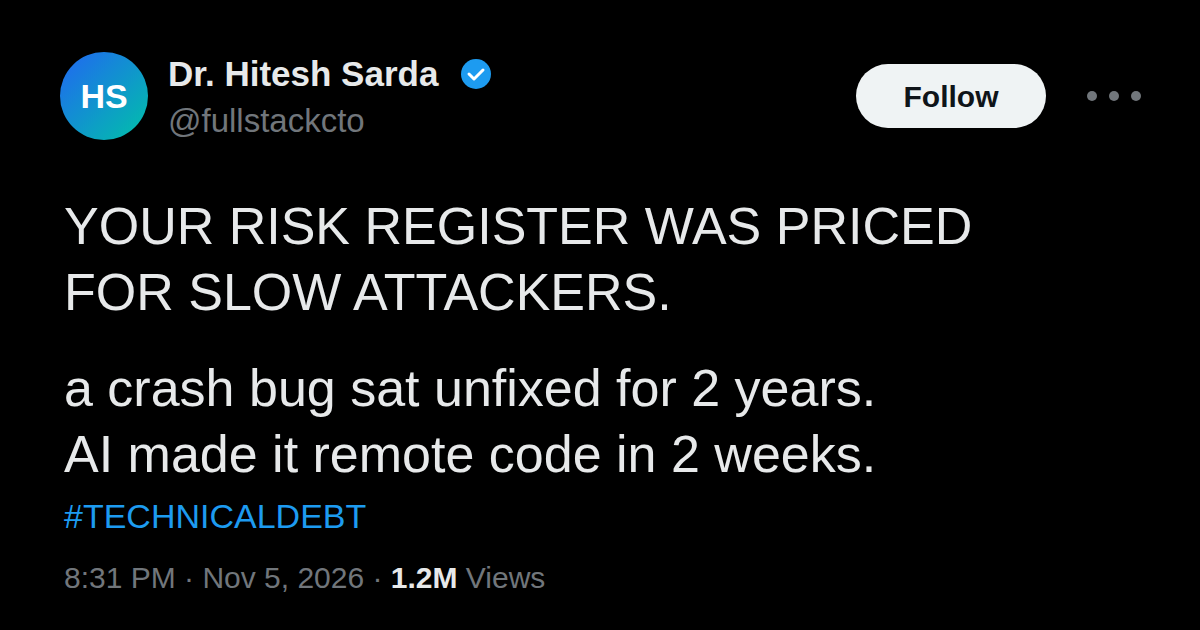
AI just raised the interest rate on your technical debt
published: 2026-11-09 · status: canonical · expanded from the original post
The case for
Deferred security work deserves a fresh priority review—not because every legacy system suddenly needs replacing, but because the assumptions behind accepting its risk may have changed.
The useful detail in this article is the asymmetry: AI accelerates vulnerability discovery and makes exploit development cheaper, while remediation still moves at human speed.
For enterprise teams, that changes the economics of leaving an exposed service untouched for another quarter.
Source: https://hitesh.in/2026/ai-raised-the-interest-on-technical-debt/?utm_source=tldrit
The case against
An AI-driven threat narrative is not a reason to move every security ticket ahead of product delivery. A rushed migration can introduce failures, and a larger vulnerability backlog does not tell you which systems create the greatest business exposure.
The tension is faster discovery versus finite remediation capacity. Reprioritizing everything does not resolve it.
My take
I would revisit deferred security tickets and accepted risks before adding another scanning tool.
Start with internet-facing services: confirm ownership, check whether they still serve a business purpose, and retire those that do not. For the remainder, prioritize using exposure, exploitability, business impact, and compensating controls—not ticket age alone.
Give each accepted risk an owner and a review date. Track remediation lead time alongside the age of unresolved high-risk exposure.
I would fund that targeted work before approving a broad rewrite. Reduce the exposed surface, then shorten the path from finding to verified fix.
Originally covered at hitesh.in ↗